Wednesday, February 4, 2015

Wishon: What lofts should your clubs be?

Proper loft fitting involves more than just the loft of the driver. Since loft is the main factor of shot distance, trajectory and backspin for each club in the bag, the clubfitter has to consider several factors for each golfer when making the recommendation for the best lofts for each club.

Factors for determining loft

Screen Shot 2015-01-12 at 3.14.36 PM
Key to this is the right set makeup for each golfer. As such the most important golfer inputs that are used to help determine the best initial lofts prior to hit testing are shown above.
The following is an overview of the key points in loft determination for the driver, woods, hybrids and irons.
The higher the clubhead speed and the more upward the angle of attack, the lower the driver loft should be for optimal tee shot performance.
The lower the clubhead speed and the more downward the angle of attack, the higher the driver loft should be for optimal tee shot performance.
Launch angle is the No. 1 most important launch monitor parameter to observe and react to in determining the golfer’s best driver loft. Spin outputs come a distant second behind visual observation of the ball flight and the golfer’s clubhead speed. The higher the clubhead speed, the more possibility there may be for a spin issue to be considered in the fitting of the loft. But never should the spin output of the launch monitor trump the importance of the observation of the ball flight shape.
Too many golfers focus too much on the backspin measurement for the driver on a launch monitor –  ball flight shape tells you more about driver backspin fitting than a launch monitor.
Learn what a driver shot hit with too much backspin looks like. Achieving the best launch angle and ball flight shape is more important than achieving the best backspin measurement.
Loft is the No. 1 way to change backspin and launch angle. The shaft will change spin and launch angle for golfers with later-to-releases, but only SLIGHTLY. The only way the shaft can reduce backspin for a golfer with an actual high spin problem is if the new shaft is stiffer overall and or stiffer in the tip section than the golfer’s current shaft. It is NEVER wise to increase stiffness in a shaft beyond what is the golfer’s proper flex and bend profile as the way to try to reduce the spin.
When the golfer does actually have a problem of too much backspin with the driver — one that is verified with a visual analysis of the ball flight shape – 98 percent of the time it is a problem that has to be resolved by a swing change and not from an equipment change.
Knowing the lowest fairway wood loft and lowest iron loft that the golfer can hit consistently well up in the air to achieve proper carry distance is the key for choosing:
  1. The golfer’s first fairway wood after the driver.
  2. The number of hybrids or high-lofted fairway woods a golfer needs.
  3. The first iron in a golfer’s set.
This is why proper loft fitting also involves deciding what the golfer’s best set makeup will be at the same time.
If you doubt the golfer’s own evaluation of the lowest loft wood and iron they hit consistently well, always recommend more loft for the first fairway wood after the driver and one more hybrid or high-lofted fairway wood before starting the iron set makeup.
The current lofts of the golfer’s irons play a role in iron loft fitting because no golfer wants a new set of irons that he hits shorter in distance per each number. There is nothing wrong with very low lofts in an iron set as long as the correct judgment is made for the golfer’s set makeup recommendation. For example, the stronger the lofts in the irons, the more hybrids or high-lofted woods there would be and the higher the number of the first iron.
Much lower-lofted iron sets may require a change in the set makeup such that the golfer’s first iron may need to be a 6 iron or even a 7 iron. Never fit a golfer with a loft that he/she cannot hit well up in the air to fly with reasonable consistency.
Loft gaps between clubs should be greater as the golfer’s clubhead speed is slower
  • 4-degree gaps: 5 iron swing speed of 80 mph or more
  • 5-degree gaps: 5 iron swing speed of 65-to-75 mph
  • 6-degree gaps: 5 iron swing speed under 65 mph
Nine times out of 10, when a golfer hits the ball VERY high the reason is a swing error in which the golfer is releasing the club in a way that allows the clubhead to pass the hands before impact and thus adds dynamic loft to the clubhead to result in the very high flight. In such cases, lower loft(s) will only help a little. The remedy to bring the ball down to a reasonable height will almost always be lessons to correct the impact position error.
Clubhead center of gravity (CG) can help more with loft fitting to achieve a little bit better trajectory for proper carry distance in the fairway woods first, hybrids second and irons last. But the effect of CG on shot height is ALWAYS proportional to the golfer’s club head speed and angle of attack.
The higher the clubhead speed, the more the CG can visibly affect the trajectory of a given loft angle and vice versa.
The more downward the angle of attack, the less the CG can visibly assist the trajectory from a given loft angle.
In other words, the slower the clubhead speed and more downward the angle of attack, the less the CG has any effect on shot height and the more that loft becomes the only factor to improve shot height and with it, proper carry distance for optimizing distance.

Wishon: What length should your clubs be?

The Meat of the Fitting: Putting it all Together to Come up with the Initial Fitting Spec Recommendations
Screen Shot 2014-12-19 at 2.49.12 PM
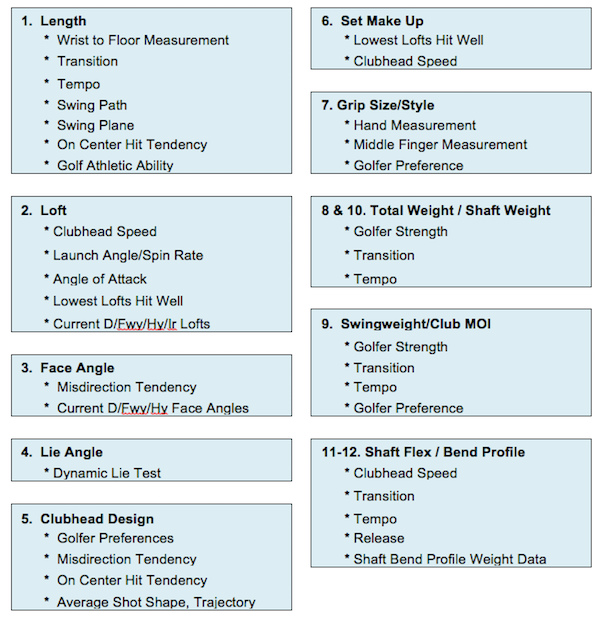
The information in the blue boxes reveals what observation/measurement inputs are to be consulted to make the decisions for what each of the 12 key fitting specs should be for each different golfer. With 12 separate specs to determine, one might think that it would take a very long time to consider each input, one at a time, to come up with each fitting spec. Not so to the trained and experienced clubfitter.
Here’s why: If you look closely at all the inputs for each of the key fitting specs, you will see that many of the key fitting specs rely on some of the same inputs. For example, the golfer’s transition is a swing characteristic in which the golfer starts the downswing with either a strong/forceful/aggressive move, a smooth/passive/rhythmic move, or somewhere in between.
Once the experienced clubfitter observes the golfer’s transition move to start the downswing, his training leads him to make initial decisions for the length, shaft weight, total weight, swing weight/MOI, shaft flex and shaft bend profile SIMULTANEOUSLY. The key difference between the GOOD clubfitter and the not-so-good one? Multi-tasking!
The good clubfitter not only knows that the transition move reveals a lot of inputs that contribute to the decision for each of these six key fitting specs, but he also knows what direction the golfer’s specific transition move indicates.
The more forceful the transition, the shorter the wood/driver length may need to be. The heavier the shaft weight, total weight and swing weight, the stiffer the shaft’s butt-to-center section may need to be as well in relation to the golfer’s club head speed and shaft swing speed range.
A smooth/passive transition move points toward a possibly longer driver/wood length, lighter shaft weight, total weight and swing weight, and a softer flex in relation to the player’s club head speed and shaft swing speed range.
The not-so-good clubfitter might not know what actual specs are determined by the golfer’s transition force, and he may not even know to observe the golfer’s transition move as an important fitting input to begin with.
The point is this: the best clubfitters not only know what key fitting spec each of the different swing characteristics and fitting inputs point to, they know what specs the inputs point to and they can keep them all circulating in their mind at the same time while they observe and measure the golfer. A proper fitting is NOT done by taking the golfer through each of the fitting specs, one at a time. Proper fitting involves knowing what golfer inputs contribute to what fitting specs and thinking about what each fitting spec should be simultaneously as indicated by each input.
I’ll put it a different way. With knowledge of what golfer inputs indicate what key fitting spec outputs, the very best fitters have a general idea of what the initial specs of the golfer’s test clubs should be by the time the golfer has finished hitting warm-up shots with different clubs. They are observing the golfer’s swing characteristics while he warms up and hits balls on the launch monitor and thinking about what each of the swing characteristics point toward in terms of specific fitting specs.
Now let’s take a quick look at the cause and effect for each input for each of the key fitting specs starting with length.
Screen Shot 2014-12-19 at 2.52.15 PM
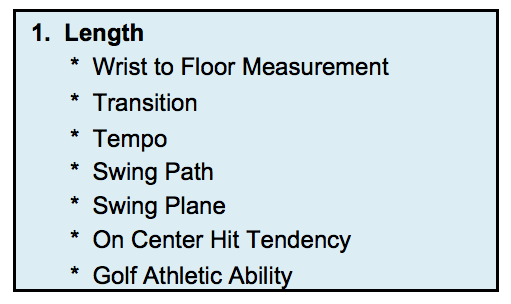
The Wrist-to-Floor measurement gives us ONLY a starting point for what lengths will becomfortable for the golfer to prevent him/her from bending over too much, crouching down too much, standing too straight and otherwise putting the golfer into a position that is less than optimal for their stance, posture and swing from a comfort standpoint. The FINAL lengths become a matter of combining the analysis of the other six points in the above chart with this basic credo in mind.
  • The more forceful the transition, the faster the tempo, the more outside-in the swing path, the more upright the swing plane, the more the golfer has problems with off-center hits, and the worse the golfer’s athletic ability, the SHORTER the lengths need to be within the golfer’s comfort level over the ball and in relation to the starting point for length from the wrist to floor measurement.
  • Conversely, the smoother the transition and tempo, the more square to inside-out the swing path, the flatter the swing plane, and the better the golfer’s athletic ability,the LONGER the lengths could be beyond the wrist-to-floor measurement starting point. Remember, it’s COULD BE — not should be — because longer lengths beyond what the swing characteristics and comfort considerations dictate do contribute to a drop in shot consistency, swing repeatability and a decrease in the center hit performance.
The very best clubfitters also know which of each of these seven inputs for length fitting carries more weight with regard to making the final determination for the best lengths for the golfer. In addition, far more thought and analysis is placed on these inputs for driver and wood fitting because of one more basic club fitting credo related to length fitting.
The longer the length beyond what is necessary for golfer comfort and consistent stance/posture position, the more difficult the club will be to swing consistently for EVERY golfer. 
Following is a compilation of additional points about fitting length that we teach to clubfitters to help them become more and more proficient.
  • Not more than 10 percent of all men should ever try to play with a driver length that is longer than 44 inches.
  • Most average male golfers should consider a driver length of 43 inches to 43.5 inches.
  • Virtually no women golfers should try to use a driver length longer than 43 inches, most women should use a driver length shorter than 43 inches.
  • When in doubt, err on the side of shorter length for the driver.
For a male golfer to be correctly fit into a driver length longer than 44 inches or a woman golfer to be correctly fit into a driver length longer than 43 inches, the golfer should possess the following swing characteristics:
  1. Smoother Transition Force and Smoother Swing Tempo
  2. Inside-Out-to-Square Swing Path
  3. Later-to-Very-Late Release
  4. Average-to-Flatter Swing Plane
  5. Above-Average Golf Athletic Ability
The second longest wood should never be longer than 43 inches for men or 42 inches for women — the second longest wood is lowest lofted wood that the golfer can consistently hit for shots off normal fairway lies. More will be covered on this in loft fitting, but you never want to fit a golfer into a fairway wood loft that he/she does not have the ability to get well airborne with good consistency. So for some golfers, their second longest wood might be a 3 wood, but for most and others it may be the 4, 5 or even a 7 wood.
  • If the golfer’s best driver length is shorter than 44 inches, the second longest wood should be 1 inch shorter than the driver. If the golfer’s handicap is more than 15, make the second-longest wood 1.5 inches shorter than the driver.
  • The length increment between fairway woods should not be less than 1 inch. Less can contribute to compressing the distance gap between woods.
  • The wrist-to-floor measurement is a good way to start the length fitting process for the irons or hybrids, but not for the driver or woods. Driver and wood length is purely about what lengths offer the most control, consistency for the golfer’s ability.
  • Being taller than average height does not mean you have to play with lengths that are longer than standard. It is the combination of height + arm length + posture and stance that determines each golfer’s best iron and hybrid lengths.
  • It is the golfer’s swing characteristics and golf athletic ability, however, that determines each golfer’s best driver and wood lengths.
  • Hybrids should be fit to the same length as the irons being replaced with hybrids.
Exception: A hybrid can be longer than an iron of the same loft when the player wants the hybrid to replace a fairway wood.
  • Using 3/8-inch increments between the irons can be good for all golfers to offer more comfort and stance consistency with the higher loft irons to result in better shot consistency and accuracy with the higher loft irons.
  • There is no specific rule for wedge length fitting – golfer comfort and golfer stance/posture is the guide for wedge lengths after the PW. Increments of 1/4 inches, 3/8 inches, 1/2 inch or even same length are all acceptable depending on the golfer’s comfort, stance/posture and manner of play with each wedge.

Wishon: How to choose the right club head.

Most golfers have to like they way their clubs look at address, so the psychological side of club head selection is very important. If golfers don’t like the way their new clubs look, the success of the overall fitting can be in jeopardy — regardless of how much improvement there is.
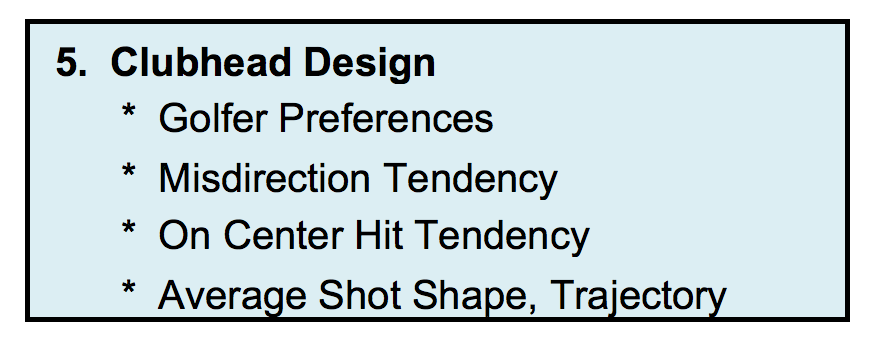
That’s why it’s important to fit golfers into club heads that have the potential to improve their performance (misdirection tendency, overall launch conditions/trajectory, etc.), but also keep the shape and style of the club heads a priority.
Screen Shot 2015-01-30 at 1.29.23 PM
Clubhead shape/style elements to identify and match to the golfer’s preference typically involve height and blade length of the head, sole width, topline width, topline slope, leading edge radii, offset/face progression, sole radius/bounce/design, back design, and so on.
But while most of these aspects of the “look” of the head may be judged on an esoteric or qualitative manner, there are most definitely performance-based elements of the head design that have to be a very important part of the fitting of the clubhead. As such, there always has to be a balance in the clubfitter’s recommendation and the golfer’s acceptance of the head model.
That’s why when we teach clubhead model fitting, we begin the process by stressing the following guideline to clubfitters:
  • Within all of the clubhead models that satisfy the golfer’s personal preferences for shape features, style, finish and cosmetics, recommend the ones that have the highest MOI and the best off-center hit performance.
  • If the golfer also needs the utmost in distance and forgiveness for his ability and game-improvement goals, expand your recommendation to include the ones with the best face design for highest COR and best variable thickness construction.
When it comes to the pure performance side of clubhead fitting, the more experienced clubfitters will also keep these points in mind:
  • For golfers with a definite need to reduce a slice or hook, recommend driver, wood and hybrid models that are available in different face angle options or those can be adjusted or bent to achieve the correct face angle to reduce the misdirection tendency.
Center of Gravity (CG) changes  — either higher/lower or closer/further back from the face to achieve trajectory, shot shape, spin and shot height fitting goals — certainly can be attempted in the head recommendation. The effect of such CG changes may not bring about as much shot shape improvement as hoped, however, because they are so much affected by individual golfer characteristics of clubhead speed, consistency of the delivery of the head to impact and swing error tendencies.
In other words, don’t expect too much change in shot shape from a CG difference in a clubhead unless you are a more accomplished player with a higher-than-average clubhead speed and a proper impact position.
This does not mean that the clubfitter should ignore the benefits of a lower or more rearward-located CG for golfers with slower swings speed or those who need help keeping the ball in the air. Just don’t expect a big change in doing so.
While the final decision for the clubhead is always in the hands of the golfer, clubfitters should do their best to diplomatically explain the tangible benefits for using a clubhead model with a higher level of game improvement features than the golfer may think they need. Golf is a tough game to begin with and using a clubhead that cannot reduce the negative effects of swing errors is not the wisest decision if the goal is to play to the best of your ability.

What matters, what doesn’t

It usually takes BIG differences in head design technology to bring about small-to-medium differences in shot performance.
  • A COR difference of 0.030 or more is significant for distance increase. A difference of 0.010 is not.
  • An MOI difference of more than 1000 g-cm2 is significant for improvement on off-center hits. A difference of 600 g-cm2 or less is not.
  • A vertical CG difference of more than 5 millimeters is significant for shot height and spin differences. One less than that is not for the vast majority of golfers.
  • A face-to-back difference in CG of more than 8 millimeters can be significant for shot height and spin differences, but only for golfers with later-to-very-late releases. A face-to-back difference in CG of 5 millimeters or less is insignificant even for later release players.
  • The more radius on the iron sole from face to back, the better the sole design is for EVERY golfer to very slightly help reduce the degree of “fatness” of a slightly fat shot. More face-to-back sole radius is also good for more consistent sole-to-turf interaction with Bermuda-type turf as well as for shots hit from the rough.